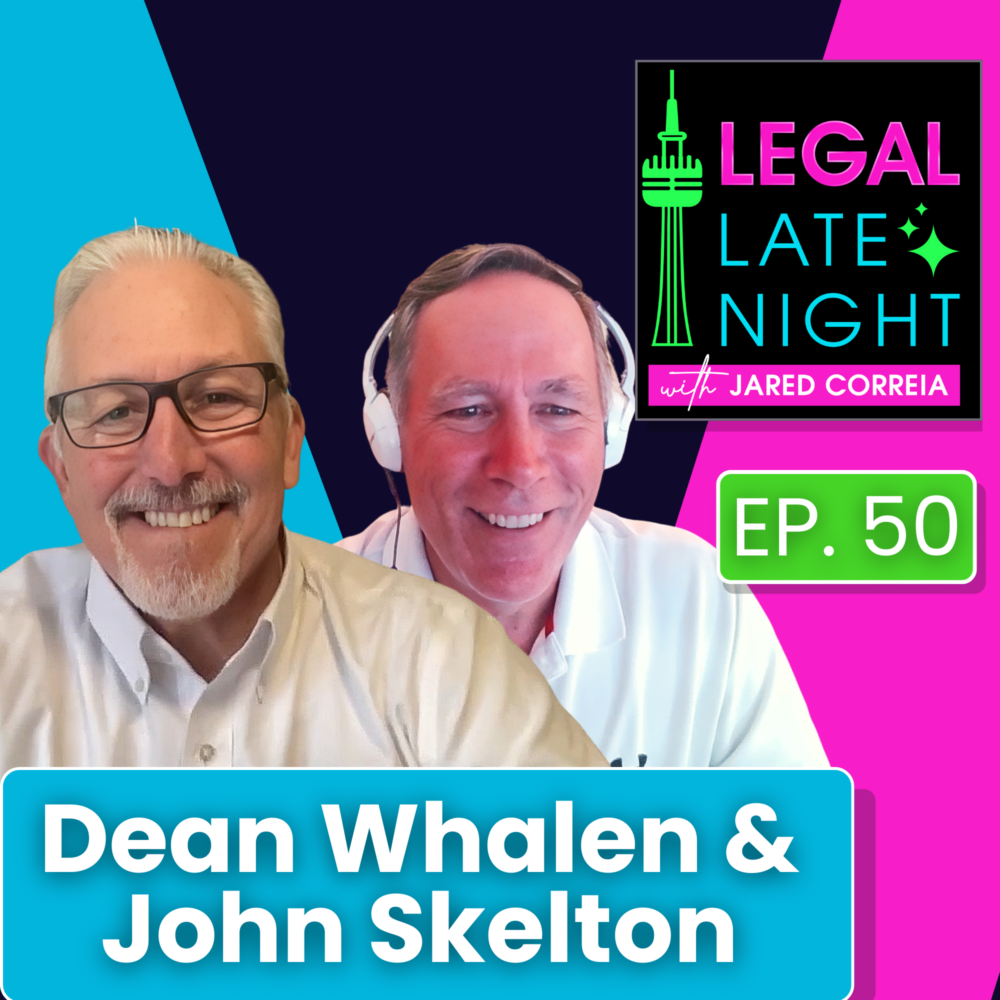
ReadBack CLO Dean Whalen and Seyfarth Shaw Partner John Skelton join the program to reveal how real-time AI transcripts are creating an insurmountable competitive advantage in the deposition room. This episode bridges the gap between the “Bill Lumbergh” style of micromanagement and the high-stakes legal strategy that kept the New England Patriots in Foxboro.

Jared Correia (CEO of Red Cave Law Firm Consulting) tackles the “Bill Lumbergh” problem in the legal industry: micromanagement. Jared explores how managing attorneys can find a balance between oversight and obsession by leveraging modern case management and workflow tools to “observe without being menacing.”
Next, the show features a rare “double guest” interview with Dean Whalen, Chief Legal Officer of ReadBack, and John Skelton, Partner at Seyfarth Shaw, LLP. In an incredible trip down memory lane, John Skelton shares the inside story of how he helped keep the New England Patriots in Foxboro in 1993 by leveraging a unique stadium lease to block a move to St. Louis.
The conversation dives deep into the future of litigation with ReadBack, an AI-based deposition software that provides “real-time” text to attorneys. In this interview, we cover:
Finally, the trio revisits the 1980s in the Counter Program for a high-stakes round of “Guess the Next Lyric,” where Dean reveals his surprisingly deep knowledge of Janet Jackson trivia.
Jared Correia (00:00):
Hello everybody. We’ve got a show that promises to be at least mildly interesting for your listening and watching enjoyment. I’m your host, Jared Correia. I’m the CEO of Red Cave Law Firm Consulting. For the monologue, I’ll try to help you be less of a micromanager. In the interview, we’ve got two guests, their Dean Whalen of Readback and John Skelton of Seyfarth Shaw, LLP. In the Connor program, we’re back on our music shit. It’s Guest the Lyrics, the Big ’80s edition. Now, let’s talk about how you can move on from doing the legal version of Bill Lumberg.
(00:44):
Law is a details business, so it’s a little surprised that managing attorneys are notorious micromanagers. They surely feel like they have to be because the slightest grow up brings with it the potential for maximum exposure in the forms of malpractice complaints, ethics investigations, and pissed off clients. Every job brings with it pressure, but pressure is magnified for attorneys, especially since the dire responsibilities and severe obligations of managing subordinate attorneys and staff are clearly laid bare in every single ethics code regardless of your state of licensure. The rub, of course, is that being micromanaged is really super annoying and skilled managers tend to avoid that strategy and how they work with their employees. In terms of how best to work with subordinate lawyers and staff, it helps immensely to change the preposition. Rather than focusing on people who work for you, think instead of the people you work with and your approach to managing should change for the better.
(01:48):
But micromanagement in the legal field is mostly worn out of the fact that there is a compelling neurosis, as I mentioned, to avoid mistakes, especially those mistakes that others may make on your behalf over which you have less control than you do over your own actions, of course. The only way that managing attorneys would feel truly comfortable is if they could watch everything their employees do every moment of their workdays. Of course, that’s physically impossible. There’s just not enough time, even if you could do it, but trying to achieve the most frequent possible level of observation is also exhausting for both parties, the supervisor and the supervisee. So managing attorneys have to find the appropriate balance between oversight and obsession. Fortunately, there are modern technology tools that make management easier than this ever been. Now, you can watch without yourself being observed. Monitor without being menacing.
(02:48):
Law firm technology, especially case management software, workflow tools, and project management applications are best used when law firm staff are charged with creating and managing task lists or workflows. Law firms where employees are requested to build and manage workflows present a clear modus operandi for each case. Employees build the workflows. Managing attorneys approve them. Each case then offers a time sensitive checklist. This eliminates some traditional management tasks like asking how things are going. Are your TPS reports ready yet? The good news is that you don’t have to ask how things are going anymore. You can just look at the shared case file to check in on the progress of the matter. So let’s say a motion was supposed to be filed on March 6th. If it was, the task will be checked off and the document will be uploaded to your system. If it wasn’t, there’ll be no document and the task will not be marked as complete.
(03:46):
And I know what you’re thinking. The damage has already been done at that point, so placed or have placed ticklers or reminders on your task list so that both you and your employees can become aware of upcoming deadlines. Everybody then becomes aware, not only of the due date, but there’s a reference point to the timeline surrounding the due date. So you get the specific application and the broader application. In other words, each task needs to have a doer and a supervisor attached. The use of Ticklers also makes it easier to review case status in a non-obtrusive way. It’s easier to send a quick check-in email or to have an easy conversation about whether anybody needs help in completing the brief that’s due, for example, than to hover over obnoxiously the entire time people are trying to do work. And I get it. Traditionally, law firm status meetings were unwieldy, long affairs, boring meetings, sometimes taking place on the weekends.
(04:44):
I know I’ve been there, but with the right technology in place and the availability of workflow and project management tools, it’s so much easier to observe and manage from a distance. And when you do meet, those meetings will be highly productive since most of what you would have had to review previously is mostly fleshed out already in the form of case specific workflows. Your meetings will be infinitely more productive and effective because you’ll only be dealing with higher order issues, deserving of immediate attention rather than rote tasks that should have already been locked down. So Ditch, the Big Brother management thesis, and instead adopt an approach grounded and process that also addresses your own staff’s agency in a far more compelling way than old school law firm management ever did. Now, let’s talk about more shit you can do to improve your practice, because that’s what we do here.
(05:36):
Next up, it’s Dean Whalen of InforWare and John Skelton from State Farm Shaw. We’re talking about AI-based deposition software, which is kind of the balls, honestly.
(05:52):
Well, I’ve effectively run out of things to say, which is awkward because this is a podcast, so I’m just going to twiddle my thumbs and hope no one notices. No, I’m just kidding. Of course, we’re going to have our guest interview today. Actually, it’s two guests twice as nice. All right. Our guests today are Dean Whalen, who’s the Chief Legal Officer of Readback and John Skelton, who’s a partner at Seyfarth Shaw. LLP. Welcome to the show. Gentlemen, I’m going to call on you so we don’t have any crosstalk. Dean, let’s start with you. How are you doing today?
Dean Whalen (06:28):
I’m doing great. I’m doing great. I got a secret fun fact for us here.
Jared Correia (06:34):
You do? Do you want to deliver it now or would you like to
Dean Whalen (06:36):
Wait? I do. You want my fun fact?
Jared Correia (06:39):
Please go ahead.
Dean Whalen (06:41):
So the three of us have something in common. Do you know what that is?
Jared Correia (06:45):
I do. Yes. Do you want to tell people?
Dean Whalen (06:48):
Yeah. We are graduates of St. Anne some College. And based on the review of some of your podcasts, some of the monks would not be happy with your potty mouth.
Jared Correia (06:59):
I know. I don’t think the monks were happy with me while I was in attendance at the school. So I’ve got a long running thing going on.
Dean Whalen (07:09):
Well, you made it through, right?
Jared Correia (07:12):
Dean, I have a fun fact for you as well, which is that people may not know this, but basically this podcast kind of is the successor to the Legal Toolkit podcast, which was on Legal Talk Network. And many people may not know, but you were the original host of that show.
Dean Whalen (07:34):
And when they started using it, I sent them a cease and desist.
Jared Correia (07:40):
Oh, really?
Dean Whalen (07:43):
And they ignored me. And so I went to my boss and I said, “They’re kind of ignoring me. Should I sue them?” And he said, “Ah, let them have it.
Jared Correia (07:51):
” That cease and desist letter never reached me. And it only took us 15 years and we changed the name. So your cease and desist letter had the desired effect eventually.
Dean Whalen (08:03):
Yes. Yes. So
Jared Correia (08:04):
What was it? I know you weren’t like … Did you enjoy it or were you just like, “This is stupid. I don’t want to do this
Dean Whalen (08:10):
Anymore.” No, I kind of liked it, but it was hard to … It was the early days of podcasts and we didn’t have much of a marketing crew. So the five views I was getting really wasn’t making it.
John Skelton (08:29):
And four of those were family members.
Jared Correia (08:31):
Yes. There you go. Yeah. It’s the same right now, actually. Hi, mom. Now Evan Hasen when I do that. I want to assure people that they’re actual listeners of the show beyond family members. Well, it was a good start. I had a lot of fun doing it, the old version of the show. And this one’s even more fun. All right, John, let’s move over to you for a second here. I like to get people’s origin stories when they come on the podcast. So we know where you went to college. I’m going to ask Dean this in a second, so Dean, feel free to prepare. But John, how did you get to the point where you are now a partner at SafeForce? How’d you get into the law? Why did you decide to go this route? Talk to me about that.
John Skelton (09:12):
I had an interesting route. At some point, if you really want to know, my studying for the LSATs was a whole different story than Mr. Whalens. But upon graduation, got married, started a career in law enforcement. I was a police officer for three years in the state of New Hampshire, a little small town called Hopes. Oh, interesting. About a year into that, I was made the police prosecutor. So I was in court twice a week litigating cases without knowing a damn thing about the law, but loved every minute of it. And then decided that since my LSAT scores were about to expire and I didn’t want to have to take them again, I applied to law school. I went to Western New England College School of Law out in Springfield. I went at night. So it took me four years, two summer schools. I’ll pat myself on the back.
(10:11):
I did very well. I wanted to get into big law. And so after in law school, I was on law review, got great grades, went and got a clerkship at the Massachusetts Supreme Judicial Court and did a summer associate gig at the then Bingham, Dane and Gould, got an offer and I joined … I started there. I was a summer associate in 87, graduated in 88, clerk in 89 and started at Bingham in the fall of 89 and haven’t looked back. Unfortunately, Bingham lasted until 2014, then it went down the toilet and
(10:57):
Three other partners and myself and a group of associates in our franchise group, we left and went over and joined Cypharth.
Jared Correia (11:07):
Oh, nice. Okay. Well, you teased the bar prep stuff. Who was better at bar study? All right.
John Skelton (11:14):
So-
Jared Correia (11:15):
John, you sound like you were the good one.
John Skelton (11:19):
Yes. So I mean, Dean took Barbery, took the bar review courses, did all the studying and stuff like that. I took the LSATs because I needed to get out of senior comprehensive exams at St. Anson. And I would not have graduated had I had to take those senior comps. I was on pub staff my senior year, and when I was working the kitchen on Thursday nights, I used Dino’s bar review books and study.
Jared Correia (11:59):
I mean, that’s great. So Dean, how were you with the bar study stuff? Less than ideal, it sounds like?
Dean Whalen (12:07):
Yeah. Yeah. John patted himself on the back. He did well. Well, I wanted to be a lawyer. Necessary evil was you had to go to law school. I did well enough to pass law school and I did not want to go into big law. And so I was a local attorney, prosecutor, and worked with my brother for many, many years, 2025. And then I started working part-time for the late and great Ray Catuno.
Jared Correia (12:40):
Yes.
Dean Whalen (12:42):
In a court reporting-
Jared Correia (12:42):
Catuna Court Reporting Services, big name in the Massachusetts area. Yes.
Dean Whalen (12:47):
And so that was great. I was part-time and it kind of became a full-time gig. And I still am doing that. I dabble on the side doing a little criminal work on the Cape. I do OUIs on the CAPE, which- Oh,
Jared Correia (13:03):
I didn’t know that.
Dean Whalen (13:04):
Yeah, is fun. Keeps me litigating a little bit. But yeah, the whole court reporting thing, very interesting. And kind of one of the topics we’ll talk about today, how much it’s changed.
Jared Correia (13:17):
It’s changed a lot, for sure. So John, most people tell me that big law is a bad scene. They get burnt out, a lot of billable hours, but you’re still there, so it can’t be that bad. What are the misconceptions people have about that?
John Skelton (13:36):
You will work hard. So there’s no question about it. You can’t get around it. Especially as a young associate, it’s a grind. Although in today’s day and age, when I started, there were no computers on your desk. If you needed to do something, you were in the office. Today’s day and age with remote work and all that stuff, you can certainly balance life and work and everything else much easier. So going into big law, I was fortunate enough, I worked with some of the smartest, best trial attorneys in the greater Boston, New England area. I had some phenomenal people, mentors at Bingham. I learned a ton. You worked for great clients, you worked on complex cases. So from a professional perspective, it was very challenging. A little bit of high stakes, a little bit of pressure. There was a lot of zeros involved in all of those cases, but it was fun.
Dean Whalen (14:41):
Tell them the story about Orthwein trying to move the Patriots, how you were involved with that. That’s a good story.
Jared Correia (14:48):
Can we talk about this? Because that’s like 30 years ago at this
Dean Whalen (14:50):
Point.
Jared Correia (14:50):
Yeah, you can talk about it. Let me give people a little bit of background. The Patriots in … So John, correct me if any of this is wrong, but I think I got this right. Mid ’90s before Bob Craft buys the Patriots. They were very close to being moved to St. Louis and becoming the St. Louis stallions before they ever won a Super Bowl. Do I have most of that right?
John Skelton (15:10):
The timing’s a little off. It was 1993. All right. I started at Bingham in 89, so I was a fourth year litigation associate, technically fifth year because they gave me credit for that clerkship. The firm had represented the Kraft family on a number of things. And so in that early 90s, so Robert had bought the stadium out of bankruptcy and Victor Kayam, the guy, was it the Remington Razor guy? He
Jared Correia (15:51):
Was fucking
John Skelton (15:51):
Terrible. So he bought out of the same bankruptcy, he bought the team. But the way the economics were structured, all of the money was in the lease. Robert knew that. Robert is an incredible business person. And so James Orthwein, Victor Kayem crashed and burned. The NFL put Orthwein in there as kind of a caretaker owner. And so he was threatening to sue … Or not threatening. He was threatening to leave, take the team to St. Louis. Now, all of this, much of what I’m going to say is public because Glen Ordway, if you remember him from WEI things- Oh, he
Jared Correia (16:41):
Was a big
John Skelton (16:41):
Radio
Jared Correia (16:42):
Host guy in Boston.
John Skelton (16:43):
Well,
Jared Correia (16:44):
Boston’s Fourth Radio is notoriously-
John Skelton (16:46):
Boston Sports Radio. So I’m sitting in my office. I got all the paperwork spread across my desk and I of course had sports radio on in the background and saying, yeah, he really doesn’t know what he’s talking about because I got the lease right here. I know exactly what it says. So there’s basically a concept that if a lease is unique and it has a unique, valuable asset, you can’t terminate it. And so the Patriots playing in that stadium pursuant to that lease was very, very important. Now, we never got to test all of that out. There were some cases in the late ’80s, I believe, in the NHL that blocked some teams from moving. We never got to test out that theory because Robert in 1993 said, yeah, I’m going to pay the most at the time for an NFL franchise, bought the Patriots and hasn’t looked back.
(17:47):
And I remember the then partner who was kind of my supervisor at the time, stuck his head in my office and said, “The deal’s closing. Robert’s going to own the team.” I picked up the phone. I called my wife and said, “Oh, by the way, I’m getting season tickets.”
Jared Correia (18:07):
Amazing.
John Skelton (18:08):
And I still have those season tickets.
Jared Correia (18:10):
What timing on your part? It was bleak before that.
John Skelton (18:18):
Right. But I mean, in the grand scheme of the NFL, you got to have great ownership, then you have to have great coaching, and then you got to have ultimately some good players and the Patriots have lucked out in all three phases.
Jared Correia (18:33):
Oh my God. An embarrassment of riches. That was good stuff. I wasn’t expecting to talk about that today, but that’s excellent. Dean, thanks for prompting that. Well, so we’re going to get to the depositions, but I got one more question for you, Dean. You are a lawyer. You still practice a little bit, but you moved from the practice of law to working in legal tech effectively. I know a lot of people who are struggling with that choice right now. Do I give up the practice? Do I do something different? What made you decide to be like, “Okay, I’m not necessarily going to be a full-time practicing lawyer anymore. I’m going to do something different.”
Dean Whalen (19:06):
It was a progression. So one, helping a friend, be careful what you ask for. And two, it was a growing company and when Ray’s Heyday, it was probably a $14 million company that did- Big business. Yeah.
(19:25):
Yeah. Had these other disciplines. He had medical transcription, he had legal transcription and he had the court reporting piece as well as a SaaS platform. So you would imagine he didn’t have a lawyer in there. So that was a playground for a lawyer. There was so much to do just with that, trying to figure everything out. Then they wanted to become SOC two certified, so I learned all about that. And then it became some fun with some business development. I liked going out and meeting clients. We got to pitch Travelers and Allstate, some really big companies. And so there was plenty to do, and he kept kind of grabbing more and more of my time. And at the time I was in the general practice of law with my brother, and that’s a rat race. I was a better lawyer than I was businessman, so trying to grab the money as you’re supposedly litigating well.
(20:27):
So it was pretty easy after a while because the company was doing well and he incentivized me. And then the company was purchased in 2017 by Nick Maher and a company called Infoware, and they’re great to work for. And you stuck
Jared Correia (20:43):
Around. You
Dean Whalen (20:45):
Don’t
Jared Correia (20:45):
Necessarily, people stay around post-acquisition for a decade.
Dean Whalen (20:50):
No, but they got this new product and I love it. And so this is what I do.
Jared Correia (20:58):
Yeah. Yeah. All right. Well, so we’ll talk about that product because I think it’s really interesting. But John, let me turn back to you for a second. So as a practicing lawyer, how are depositions important to the prosecution of a case holistically? How do they come into play and why is this something you have to be aware of and do correctly effectively?
John Skelton (21:21):
Well, so 99% of all cases settle and they settle because, and especially in the stuff that I do, relatively high stakes, it’s all about preparation. And you’ve got good lawyers on the other side, and if your clients are going to do a real assessment of the risks and everything else associated with taking that 1% or 2% of cases to actual trial, you have to be well prepared. And to be well prepared, the key is … There was a time, and actually at the first part of my career, I got to do a bunch of ALJ cases in the auto industry where there was no discovery. You just had a file, you prepared it, you went to quote unquote trial. It was before an ALJ. And you, I don’t want to say we’re winging it, but I won most of those. I won most of those because I was better prepared holistically.
(22:28):
Yeah, that makes sense. So now in the more traditional litigation sense, you say to yourself, okay, I have to find out what the story is. So I got to go do discovery. I got to put people under oath, get them committed to that story. But in doing that, I have to have my eye on trial. How is this going to play out at trial? How am I setting myself up for … In our world, summary judgment is king because we’re going to try and get that resolved early on. And so you couldn’t … Every single deposition, whether it was of a lower level person or the CEO of the opposing party, every single deposition is crucially important and an opportunity to learn. And so Dean and I have talked off and on over the years about the importance of how court reporting has changed and how tech has changed.
(23:37):
And now we got AI, which is a new frontier that I’m just kind of coming to grips with. But-
Jared Correia (23:47):
Let me ask you this to your point. I want to get to the new solutions like Dean was talking about, but John, in a traditional deposition setting where you’ve got somebody who’s a stenographer and it’s like paper-based, what is hard about that for a modern lawyer? What difficulties does that present that some of the tech stuff we’re going to talk about might solve?
John Skelton (24:12):
So I’ll use two different examples. One is a relatively more simple case where maybe you’ve got a hundred documents, right? And so a hundred documents is still a lot. You got to know them, you got to annotate them, you got to mark them up, you got to know how to use them. A lot of the cases that we have now, it’s not a hundred documents, a hundred thousand documents. And if you think about how are you going to manage that much data and paper? Now, back in the day, we used to have highlighters and post-it notes and you used to be making a lot of post-it notes and you’d bring in to the deposition that box of exhibits and it’d have all those post-it notes. And candidly, we excelled because we prided ourselves on being better prepared than the other side.
Jared Correia (25:05):
Yeah. The Post-it note thing was always wild to me as far as traditional law practice. What if it falls off? The adhesive is not like … It’s a mild adhesive.
John Skelton (25:19):
Oh, and you can’t shuffle the papers because they’ll come off on that and yeah. Oh yeah. No, no. There was- Well, and since we’re talking about tech, at that time, paralegals were gold. So your paralegals was keeping track of all of that stuff and you had a good paralegal that you were golden.
Jared Correia (25:42):
Dean, so let’s talk about … So InfraWare is the parent company, as I understand it, and then there’s ReadBack, which is this AI deposition product, which I think is really great. Can you tell people about how that works and how that changes the game here?
Dean Whalen (26:00):
Yeah. It’s probably better to start with why we developed that solution.
(26:05):
Yeah, go ahead. So Ray was a court reporter for 60 something years and Cotuno Court Reporting. So I came in in 2005. So I got to see that legacy court reporting. And quite frankly, a look behind the curtain showed that there were a growing number of stenographers retiring, and there were good stenographers, there were not so good stenographers, there were stenographers that we couldn’t send to a job because they weren’t competent. And so over time, we started seeing a supply and demand issue, and we used independent contractors. And it got to a point where I was asking lawyers like John Skelton to wait longer for a transcript because of supply and demand and pay more. So in what world, this is around pandemic time, in what world in the information age can you ask people to wait longer and pay more? And to my CEO’s credit, Nick said to me, not in so many words, but he said, “If we can’t figure this out and fix it, it’s not really an industry I’m looking to try and advance in.
(27:25):
”
Jared Correia (27:26):
Right.
Dean Whalen (27:26):
No
Jared Correia (27:26):
Pressure.
Dean Whalen (27:27):
But
Jared Correia (27:27):
The entire company now falls on your shoulders.
Dean Whalen (27:31):
Well, to his credit, he had this patented speech to tech engine that he was using in medical discipline, insurance discipline. So we were able to teach that legal language, and we developed this AI-based … AI, it’s speech to text, right? You see AI on your phone speech to text. We have our own patented speech to text that’s encapsulated in our own environment, so there’s no outside large language models, things like that for data protection. But the speech to text with guardrails is kind of our secret sauce here because the lawyers will see the transcript come up right in front of them and we have editors in the transcripts contemporaneous with it happening so that you can see a transcript that’s pretty pristine. So that’s kind of how it happened. It took a bit to get there, but now that we’re there, now it’s kind of dragging the legal industry along with us because we still have some blockbuster hold out saying Netflix can’t come to my neighborhood.
(28:43):
So we’re going through that process right now.
Jared Correia (28:48):
Consistency, cost, obviously, of some driving factors in that.
Dean Whalen (28:53):
100%.
Jared Correia (28:56):
No one’s typing anymore. It’s just on your screen. So as the attorney, you have access to that stuff immediately, which is great because that wasn’t accessible to you before. So in that model, are there other specific advantages, Dean, that you see for attorneys who are running depositions that they really
Dean Whalen (29:16):
Have
Jared Correia (29:17):
Access to before?
Dean Whalen (29:18):
And I’ll turn it over to the expert because I joke with John all the time. He’s one of the hardest working attorneys I know. He’s got a beautiful home up on Lake Winnebasaki and he earned every bit of- All
Jared Correia (29:31):
That prep.
Dean Whalen (29:33):
Yes, yes. But the whole concept behind the real-time piece, and John gave me a lot of this, so I’ll turn it over to him in a second. But what I’d like to say is, as a company, what we realized in talking to attorneys after I spoke with John was the number of attorneys that had never tried real time. Now, John works for a big firm, they have deep … Pockets. They get a $2,000 bill for a depo. They write a check and send it. Your mom and pops and your middle attorneys get a $2,000 bill and they put it over in the corner and wait for the case to settle.
(30:15):
So that $2,000 bill becomes a $4,000 bill if you ask for real time. So BMW and the larger clients want that attorney like Skelton to be operating at the top of his game. And if John says, “I need real time,” they’re not going to blink. They’re going to pay it. Most attorneys, I’m going to say John was in the … It’s hard to believe, John, but 2% of the lawyers that I talk to use real time, maybe 5%. And so what we quickly realized is that John can talk about the advantages of real time, but we quickly realized to get to market with this and be able to offer it at a price, save the educational piece. I have to convince attorneys that they should be doing this. Yeah, I want to talk a little bit
Jared Correia (31:04):
About
Dean Whalen (31:04):
That.
Jared Correia (31:04):
Yeah.
Dean Whalen (31:05):
But now the world is. Everybody’s adopting AI. But John, talk about some of the advantages that you kind of gave me insight on that I said, we need to get this out at a good price to people.
Jared Correia (31:16):
Yeah. And John, I mean, the real-time thing is I don’t do depositions, but the real-time thing to me seems to be a massive competitive advantage that you can exercise.
John Skelton (31:27):
So I don’t remember the first real-time deposition that I took, but that was before you still have a stenographer there, but you brought your laptop, you hooked it up, you connected, and all of a sudden you had a screen there and you’re seeing the Q&A. And the big thing is we all left a deposition thinking we had nailed it. We had asked the right questions. We got great responses. We locked things down. They were never going to be able to squirm out of this on cross-examination. I got summary judgment locked and loaded. A month later, you get the transcript and you say, “Ooh, maybe I could have phrased that question a little bit differently.” Or more importantly, the witness wiggled a little bit. And because at the time we were so busy scribbling notes and with that legal pad, right? And this was something that got drilled into me by those senior mentors was when you’re taking a deposition, ask a question, listen to the answer and make sure you know and understand the answer before you move on.
(32:45):
Well, what Realtime did was it gave you a transcript. Now it wasn’t perfect, but it gave you a transcript as you were going along so I could see my question and I could see the answer. Or more importantly, I would ask my question and I’d get an objection.
(33:05):
I could pause. I could look at my question and say, “I’ll rephrase.” And now I had a do- over to ask an even better question. And then when the witness gave me a non-responsive answer, I could see it. I’d say, “Wait a minute, Mr. Witness, you’re not answering my question. I asked X.” And so the process allowed you to walk away at the end of the transcript with a transcript that you now felt much more comfortable with. Now, the other thing that realtime did is you were getting a rough at the end of the … Because it was all electronic, you were walking away with a rough. And for many cases where I would fly to New York, I’d be there for three or four days, taking three or four days of depositions back to back to back to back. Well, pre-real time, I’m sitting there with a pad trying to decipher my hand scratching to see how I was going to prepare for the next day.
(34:14):
Whereas with real time in that rough transcript, and now it’s just gotten exponentially better, you now had those Q&As. You now could search on there to find Q&As about particular topics. So now preparing for the next person, I could review what the witness just said about certain things. So it really is a game changer, and especially now that the price, it’s not double the cost. It’s comparable. It really isn’t a no-brainer.
Jared Correia (34:58):
It’s funny. I think people think of these historical analogs where you got Perry Mason and it’s like, “Can you read that back to me? ” Asking the course stenographer and now everything’s in front of your face. That’s crazy.
John Skelton (35:10):
Well, and there are times where I’ve been with some opposing counsel and they’re old school and they want to have it read back. And it’s just like, okay, this is just such a waste of time. Just read the damn thing on the screen.
Jared Correia (35:28):
Let me ask you about this. If somebody’s not experienced it before, and I’ll start with Dean and then we can move back over to John. But without the stenographer in place, it’s not like you’re just out there in the weeds by yourself, right? There’s still someone managing the process who can liaise with the company.That infrastructure is still all there, right?
Dean Whalen (35:49):
Yeah. In order for it to be an actual deposition under Rule 28, I think it is, you need an officiant, you need an officer to certify the transcript. You need an officer to make sure guys like Skelton are talking over each other and that there’s proper decline. Yeah. No. So the long and short of it is, instead of a court reporter, we call them guardians. So they’re kind of guarding the record, right? Yeah. And so they’re guardians, they’re the officiant, they’ll make sure the witness is sworn in and it’s the Wild West now. Attorney Skelton may give us a notice of deposition that’s a federal jurisdiction in Florida, and we get to the deposition and the witness is in Wyoming. Now we need to know that ahead of time because we need to swear in the witness with a proper notary and things like that.
(36:42):
So it’s crazy, but that’s the short answer to your question.
Jared Correia (36:46):
But it sounds like there’s somebody to call on whenever issues arise, at least. John, you’re
Dean Whalen (36:53):
Just about to- Or give a read back.
Jared Correia (36:54):
Yeah, yeah. Right.
Dean Whalen (36:55):
Yeah, we can give a read back. That’s pretty a read back.
Jared Correia (36:59):
What a great name. You should do something with that. John, go ahead.
John Skelton (37:06):
So COVID and remote work and remote depositions, I think kind of just opened everybody’s eyes. So I was talking to someone the other day and they asked me about travel and I said, “Well, you don’t get to travel as much because courts now recognize it’s a lot more efficient just to get on Zoom and have a status conference and you’re not wasting that. ” And so the minute we … Now we had to develop some protocols because if I’m not in the room with the witness, I got to make sure he doesn’t have a cheat sheet behind his computer with all of the answers or someone
Dean Whalen (37:43):
Isn’t
John Skelton (37:44):
Feeding him stuff under the table, but there’s protocols for dealing with all of that. But all of a sudden now we could … I remember the first kind of remote deposition that I took was probably in the mid to late ’90s. It was over the phone. We just had the old speakerphones sitting in the middle of the conference table, but you could do that. And so now with Zoom and those kind of platforms, you can be very comfortable. And especially now with exhibit sharing being part of the programs, you don’t have to schlep four boxes of documents to New York to have a deposition. You got to do a little prep work in advance, load them all into the program, but it’s much more efficient. And you then get over the concept of being in the stodgy mahogany conference room with the court reporter at the end of the table with the little machine going bang and forth.
Jared Correia (38:55):
The only problem is we’ve lost a lot of the mahogany. One last question for you guys. Dean, you brought this up earlier. I don’t know, I don’t practice law anymore, but if I’m an attorney, it seems like a no-brainer to at least try this. I think most of this is like an educational issue, like people finding out the tools like this exist. Is that fair or is that an oversimplication?
Dean Whalen (39:19):
No, I think it’s fair. I mean, I think John hit it on the head. The remote depositions took fire with the pandemic and so it was going to be, we created this solution contemporaneous with that. So we were very curious post-pandemic, how’s that going to shake out? And very few attorneys have gone back into the conference room. Some swear by it because they claim there’s a physical intimidation piece and they can eyeball the witness better and things like that. I don’t know. I was never one of those- They love
Jared Correia (40:01):
That. They love that Perry Mason shit. Yeah.
Dean Whalen (40:04):
Yeah. Yeah. But I think that what we’re finding is we do a lot of work with Nila attorneys, the labor and employment lawyers. And so they’re plaintiff’s attorneys, they’re cost conscious, our costs are going to give you this premium service at an amount that makes sense. And so there is an education piece. There’s an education piece of, why is this transcript important to me? I had one Neela lawyer say to me, “Yeah, I used to often say to my client, let’s see how the transcript reads.” I think we did well in that deposition. That’s insanity now. No, I’m sorry. Here’s where-
Jared Correia (40:49):
No, I mean, it’s fair.
Dean Whalen (40:50):
The ABA has some rules about technology in most states. They do indeed. So as attorneys, we have an obligation to stay up on technology, to be competent. I think this type of service is approaching competency, minimum competency requirements. And in a few years, I think we’re going to be there. It’s like, why are you guessing when you leave that deposition? You just lost three counts in the summary judgment you could have blown out of the water if you had simply phrased these three questions this way. So I think that’s where we’re headed.
Jared Correia (41:32):
You’re not the first person to say that. And I think some attorneys would even make a stronger statement about that and say, not using up-to-date technology as malpractice in itself.
John Skelton (41:41):
Clients are expecting it. So our clients, not only just with depositions and that kind of stuff, but AI in general, right? It’s very evolving, it’s fast tracking, but we have clients now that are expecting you to be able to utilize AI. So a quick anecdote, right? So we’ve got tools. We got AI tools built into the system. I just had a big hearing up in Concord, New Hampshire. Post-arbitration stuff is pretty complicated, a ton of cases. And so I plugged in all the briefing to AI, said, give me a hearing outline that identifies the key issues and most importantly, anticipated questions from the judge. It was pretty good. Now, I had to do a lot of work to it, but it was pretty good. But the other thing is that I fed all of the cases that both sides had cited and said, give me a summary.
(42:54):
Remember first year of law school, we were writing out those case briefs? Well, AI did all of that. Clients are now expecting you to use the … As our rates go through the roof and litigation becomes more expensive, you have to have equalizers. This kind of tech is an equalizer.
Jared Correia (43:17):
Well said. Okay. I think we should end on that note. Speaking of expectations, I think people are waiting for the counter program, which is next. John, Dean, will you hang around for the final segment?
Dean Whalen (43:29):
I’m afraid to, but yes.
Jared Correia (43:30):
Okay. Your brave souls. We’ll get to that next. All right, everybody. Welcome back. It’s the Counter Program. It’s a podcast within a podcast. This is a conversational space where we can address usually unrelated topics that I want to explore at a greater depth with my guests. Are
Dean Whalen (43:51):
There any safe
Jared Correia (43:52):
Words? Expect no lime. There are no safe words. You’re not going to need safe words. Expect no rhyme and very little reason and no safe words. Welcome back, you guys. I’m going to do something special for you guys. I feel like I’m going to take you back to maybe the best times of your lives. The 1980s? The ’80s? Yeah. You’re
Dean Whalen (44:19):
Like,
Jared Correia (44:19):
Maybe, maybe not. I thought I’d get a better response for that. All right, here we go. We did this same thing a few weeks ago and our guests flamed out terribly, so I’m bringing it back immediately, obviously. The original version of this game was a little bit too personalized, so I’m generalizing it a bit more. We’re going to play Guess the Next Lyric, The Big ’80s edition. It’s exactly what it sounds like, but since we’ve got two people on today, you guys get to compete with each other. So here’s what I’m going to do. I’m going to give you a song title, a singer or a band. I’m going to read three seconds. Can we do the 70s? And then your job is to guess the next one.
(45:00):
We’re going to do the 80s. You’ll be fine. You’ll be fine. You can throw me … You know what? If you got a 70s one that you want to throw me, you can throw a 70s one at me. I like the 70s better too, actually. I’ve got six. I’m going to give you multiple choice. So here’s what we’re going to do. John, you’re going to go first because you’ve never hosted this podcast of the three of us or podcasts like this. And then you guess, if you get it wrong, Dean gets a chance to steal and he will have a fifty fifty chance. So are you ready? I’m going a little early 80s, so I think this might be in your wheelhouse. All right, are you ready?
John Skelton (45:43):
I’m ready.
Jared Correia (45:44):
I’ve got a band called The Go Gos. You remember them?
John Skelton (45:50):
I do, vaguely.
Jared Correia (45:52):
We got the beat. You know that song? All right,
John Skelton (45:56):
Man. Vaguely, yeah.
Jared Correia (45:57):
Yeah. I’m trying to make it easy for you. I’m going easy on you guys to start with. So here’s how the song goes. We got the beat. We got the beat. We got the beat. Yeah. A little rid that. We got
John Skelton (46:11):
The beat. What’s
Jared Correia (46:11):
The next lyric? We
John Skelton (46:13):
Got the beat.
Jared Correia (46:15):
Well, let’s not go too crazy because that’s wrong. Let me give you the multiple choice.
Dean Whalen (46:23):
My turn to steal.
Jared Correia (46:32):
It’s the next lyric. We got it. Everybody move or shake it up. I don’t know. We’ve already got controversy here. Dean’s ready to steal. John was like quick on the trigger. Shake it up. Would you like to guess from those three? Wait, who was that? Was that Dean or John who said that? Shake it up.
Dean Whalen (46:53):
It was John.
Jared Correia (46:56):
Okay. John, you are now officially 0 for two. So Dean. It’s the next line. We got it or everybody … It’s A. It’s A. Oh, boy. All right. I’m keeping track. Dean’s got one point. John has zero
John Skelton (47:15):
Points. But don’t mind John. No, when I tell you about the Janet Jackson trivia, so that’s a whole other story. A whole other-
Jared Correia (47:26):
Wait, is there Janet Jackson trivia?
Dean Whalen (47:29):
All right. You’re going to hear this story. So here’s a story.
Jared Correia (47:32):
Yes, please.
Dean Whalen (47:32):
We go to the- First
Jared Correia (47:33):
Of all, you
Dean Whalen (47:34):
Guys are like,
Jared Correia (47:34):
Let’s do the 70s and then you’re like, I’m a Janet Jackson expert. All right, go ahead.
John Skelton (47:39):
No,
Dean Whalen (47:39):
He is.
(47:41):
So we went to the Houston to the Patriot Super Bowl with no tickets. And we’re walking around acting like middle-aged, maybe even over middle-aged knitwits. I’ll speak for myself. And somebody from CBS saw me and walked up to me and said, “Hey, we’re running this trivia question on MTV. Would you like to be a part of it? ” And I said, “Sure. I’d love to be a part of it. ” So this is what happened. On national television, they asked me questions about Janet Jackson, who was the halftime, versus somebody who was a dancer, Jovan, and he was quite a dancer. And they asked him questions about football. So we went toe to toe and I won the tickets. So there’s the Janet Jackson. Oh,
Jared Correia (48:28):
Amazing. That’s
John Skelton (48:29):
Great. So while the rest of the crew was out celebrating and enjoying the Houston nightlife, he was in his room studying Janet Jackson. So I’m at a disadvantage on all things music.
Jared Correia (48:44):
I mean, Dean is off to a hot star. That is true.That’s beautiful. Now, that must have been the wardrobe malfunctioned Super Bowl, right?
Dean Whalen (48:53):
Yes. Yes. Okay. And I knew, I called my friend and said, I know more about Janet Jackson than I’ll ever want to, including that her left nipple is pierced.
Jared Correia (49:08):
And now the world knows.
Dean Whalen (49:09):
That was two hours before the Super Bowl. This is a true story.
Jared Correia (49:14):
And
Dean Whalen (49:14):
Two hours later-
Jared Correia (49:15):
Trivia questions, that’s crazy. Two hours later, everybody knew.
Dean Whalen (49:18):
We were in early. I just said to him, I know more about her than I ever wanted to. And that was one of the things I knew about her. That is funny. We all got to see it. Deep research. He
John Skelton (49:26):
Studied more for that Janet Jackson trivia than he did for the bar.
Jared Correia (49:33):
As one should, honestly.
Dean Whalen (49:35):
I didn’t see you complaining. I handed you a Super Bowl ticket.
Jared Correia (49:39):
It’s all good. Right. Rhythm Nation 1814. That’s a great album. All right. Dean, are you ready to continue your trivia dominance?
Dean Whalen (49:49):
Sure.
Jared Correia (49:50):
Duran Duran. Hungry Like the Wolf. You know this one? It goes a little something like this. I’m trying not to sing these songs to give anything away. High blood drumming on your skin. It’s so tight. You feel my heat. I’m just a movement behind. Do, do, do, do, do, do, do, do, do, do, do. I think that’s all of them. It’s the next lyric. A, I’m hunting through the city lights. B, you know that I am coming for you or C, in touch with the ground. I’m on the hunt. I’m after you. What is the next line in Hungry Like the Wolf? A, B or C. I can repeat those if you’d like.
Dean Whalen (50:31):
B. B.
Jared Correia (50:34):
B, you know that I’m coming for you. That is not correct. That is in the song, but not at that point in the song. John, you have a chance to steal.
John Skelton (50:46):
A.
Jared Correia (50:47):
Is it A, I’m hunting through the city lights or? Oh, it is C. It is C. In touch with the ground. I’m on the hunt. I’m after you. All right. Dean, you’re still in the lead here. Trivia Maven. John- Told you we should have done the 70s. Now we should have done the 70s, but you would’ve known more answers in the 70s. That’s not the vibe we’re going for here. All right. Next, Madonna, like a virgin. Goes a little something like this. Very controversial song back in the 80s. I was beat incomplete. I’d been had. I was sad and blue, but you made me feel A, like I finally found the truth. B, you made me feel shiny and new. C, like the world was made for two. The next line and like a virgin. A, B or C. I can read those again if you like.
John Skelton (51:47):
C.
Jared Correia (51:48):
You only got one more shot to guess first after this. C. Like the world was made for two. No, it is not. We’re down to A. Like I finally found the truth. Or B? Yeah, you made me feel shiny and new. Dean is like in his hotel room studying 80s Madonna. Is it A or B?
Dean Whalen (52:11):
Gyne and new. B.
Jared Correia (52:13):
Yes. Yes. Dean is killing this. All right. I’m personally impressed. I didn’t think it would go this well. Dean’s up two to nothing. John, I still believe in you. You still got a shot here. You’re not mathematically eliminated as yet. Dean, next song for you. Toto’s Africa. Huge hit in the 80s. The lyrics go. It’s going to take a lot to drag me away from you. There’s nothing that a hundred men or more could ever do. I bless the reigns down in Africa. Is it A, I know I must do what’s right. B, to find the things we never had. Or C, going to take some time to do the things we never had.
Dean Whalen (53:00):
C.
Jared Correia (53:01):
Correct. Oh my God. Domination. Sorry, John. This is highly impressive. And that’s like a weird lyric. It’s not even grammatically correct. I
Dean Whalen (53:15):
Actually- John. Remember that song well.
Jared Correia (53:18):
Yes. I mean, if you’ve heard the lyrics a bunch of times, they sort of start to bring in your head. John, it’s now or never. Dean, of three to nothing. But this is your chance to get a point here. Don’t be shut out. We’re going with Whitney Houston for this one. How will I know? Famous Whitney Houston side from 80s. How will I know if he really loves me? I say a prayer with every heartbeat. I fall in love whenever we meet. Is the next lyric A, I’m asking you because you know about these things or B, I hope he feels the same way too. Or C, my heart is beating like a drum. John, do you have a guess?
John Skelton (54:05):
I have a guess. It’s a real guess. B.
Jared Correia (54:09):
B. That is not right. John, stick to depositions.
John Skelton (54:18):
I don’t get the 70s.
Jared Correia (54:22):
I’m going to have to bring you back and do a 70s trivia. We’ll leave Dean out of it because obviously he’s a trivia. He’s a killer on the trivia. All right. Dean, is the lyric, I’m asking you because you know about these things or my heart is beating like a drum.
Dean Whalen (54:39):
A. I’m asking you- A is correct. Did you know about these things? Damn.
Jared Correia (54:47):
Dean. Oh my God. All right. Let’s do the last one. We got one more. John, you have no hope of coming back, but you might be able to steal this one. All right. I got a little Don Henley for you. The Boys of Summer. Maybe the most poverty Don Henley sign there is. But I can see your brown skin shining in the sun. You got your hair combed back and your sunglasses on, baby. Is it A? I remember how you used to shine. B, and I can tell you my love for you will still be strong or C, those days are gone forever. I should just let them go. Dean, do you have a guess? The next lyric
Dean Whalen (55:30):
In those
Jared Correia (55:30):
Verses.
Dean Whalen (55:31):
I think it’s D.
Jared Correia (55:32):
I don’t want to give you any hints,
Dean Whalen (55:33):
But-
Jared Correia (55:34):
B. It is B. Correct. Oh my God. Superlative performance here from Dean. I mean, five points on the trivia. Sorry, John. Dean was just a road grader in that section. That was so super impressive.
John Skelton (55:51):
So my only hope is that next week he’s coming down to Florida. We’re going to have a couple golf matches. I hope he just … I’ll give him the trivia victory. I want the victory next
Jared Correia (56:05):
Week. You want the golf victory? Okay. So John, I
John Skelton (56:08):
Have to
Jared Correia (56:08):
Have you back solo. We’ll do 70s music trivia. We can tell Patriots stories we’ll do 70s music trivia. It’ll be amazing.
Dean Whalen (56:17):
There you go.
John Skelton (56:17):
Because that’s what I listened to in the golf cart. I listened to 70s rock.
Jared Correia (56:24):
Hey,
John Skelton (56:24):
For
Jared Correia (56:24):
Me, maybe you can throw out a little Whitney Houston when you’re on the links next week.
John Skelton (56:29):
Well, I’m now going to have to do a few of those.
Jared Correia (56:35):
Guys, thank you. This was a lot of fun. Thanks for our guests, Dean Whalen, the chief legal officer at InfraWare and John Skelton, a partner at Seyfarth Shaw, LLP. To learn more about Dean and InforWear, visit inferwear.com. That’s I- N-F-R-A-W-A-R-E.com, infraware.com. To learn more about John and Sayfarth, visit safefarth.com. That’s S-E-Y-F-A-R-T-H.com, safefarth.com. Now, because I’ll always be a 90s kid who fondly remembered Fraggle Rock, but whose due passion is burning CDs for anyone who would listen. I’m now just doing the modern version of that, which is creating Spotify playlists for every podcast episodes I record where the songs are tangentially related to an episode topic. For this week’s playlist, we’ve got a grouping of songs very well fit to the middle of April, I’d say. It’s Showers Bringing May Flowers in his rain songs and is sponsored by Fruit Stripe Gum. I’m hearing that in a tragic turn of events, Fruit Stripe Gum has been discontinued despite the siren song of an iridescent zebra mascot named the Ipes, perhaps in another timeline.
(57:55):
Join us next time when I continue to relish my short time on planet Earth.

Dean Whalen is the CLO of ReadBack and an expert in leveraging AI to modernize the litigation process through real-time transcript technology.

John Skelton is a Partner at Seyfarth Shaw, LLP, known for high-stakes litigation.