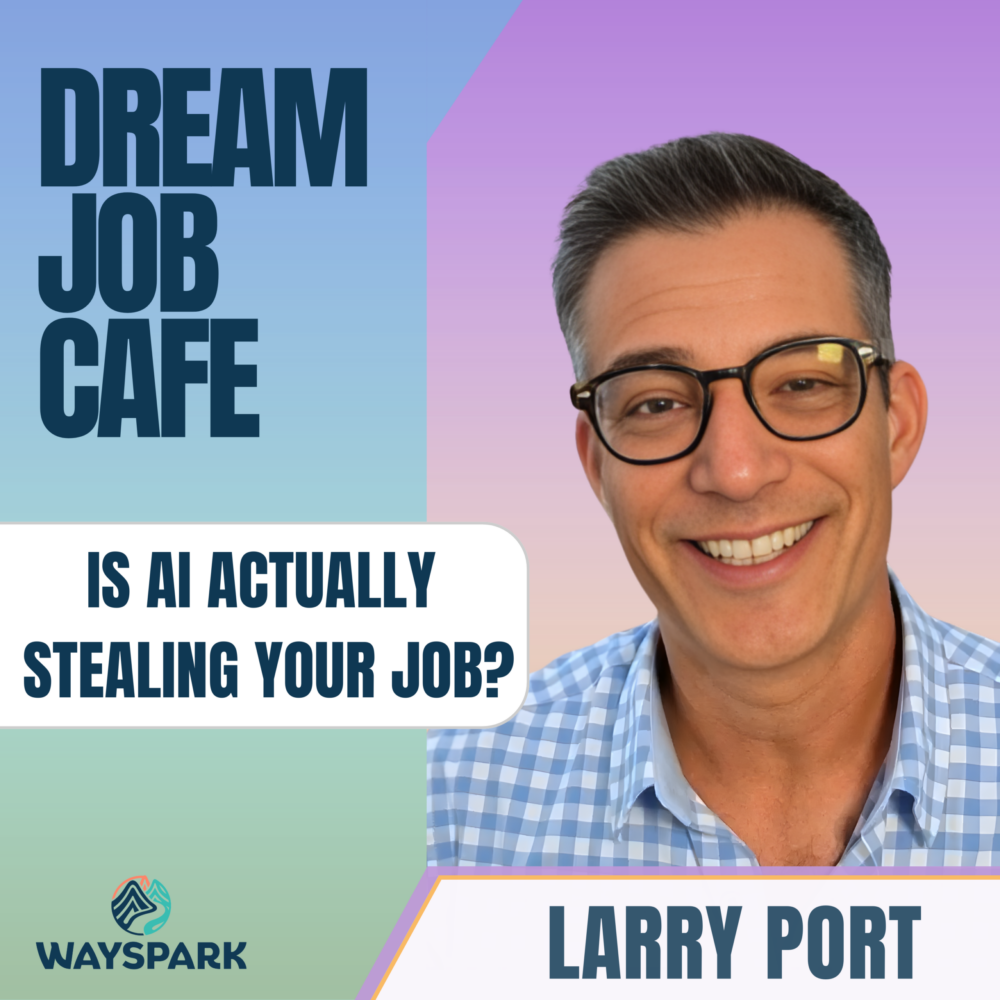
In this solo edition of Dream Job Cafe, I’m digging into the data to answer the question keeping every white-collar professional awake: Is AI coming for my paycheck? Sponsored by Wayspark, we’re cutting through the clickbait to look at why the current job market “malaise” has more to do with boomer congestion than bot takeovers.
If you’ve been following the news in the spring of 2026, you’ve seen the headlines. Doom-mongers are shouting that AI is a “job gobbler,” and CEOs are bragging about layoffs as if they’re the first to the table of efficiency. I wanted to use my platform at Wayspark to actually look at the academic research and economic reports coming out of the Bureau of Labor Statistics and the New York Fed.
The consensus? I’m an optimist, but the data backs me up: for the most part, the gains from new types of employment are going to offset the losses. We’re in a period of transition, not a period of collapse.
A recent New York Times report highlighted that while it is undoubtedly hard for young people to find work right now, AI is likely just a margin player. The real impediment is a “low hire, low fire” dynamic. Think back to the post-2008 collapse or the height of COVID—those were hard times for graduates, too.
Today, we have a unique “Software Engineer” phenomenon. We saw massive layoffs, but that wasn’t just AI writing code; it was the end of “talent hoarding.” During the wars between Facebook, Microsoft, and Amazon, these companies kept brainpower on the bench just to keep them away from competitors. When the bubble popped, the bench got cleared.
Another major factor gumming up the works is the sheer volume of older workers in the force. Since the 1970s, Americans have worked longer as life expectancy increased. But there’s a deeper reason: healthcare. In this country, your health insurance is tied to your job. When you’re 65, that insurance is more valuable than ever, so you stay in that senior role. This creates a “congestion” at the top, preventing mid-career employees from moving up and entry-level workers from getting a foot in the door.
Remember when everyone said radiologists would be replaced by offshoring and then by AI? It made sense on paper: a scan is just a digital image, right? But it didn’t happen. Why? Because patients and providers like having a human around to explain what they’re seeing.
The most mind-boggling stat? Since Google Translate launched in 2006, the number of human translators and interpreters in the US has actually risen by 73%. Technology commoditizes the basic task, which makes the human “concierge” experience even more valuable. As long as humans are “creatures of habit” and businesses remain “risk-averse,” we will pay for human judgment.
In his new book, Reid Hoffman (the guy who started LinkedIn) points out that we’ve been here before.
In the podcast series The Last Invention, experts point to the “electrification of America” as the blueprint for AI. Electric dynamos were everywhere by the late 1800s, but it took forty years for those dynamos to show up in productivity statistics. Factory owners didn’t see efficiency gains overnight because they had to figure out how to reorganize their entire workflow around the new tech.
AI is the same. It’s not about the software being invented; it’s about how fast an organization can communicate and adapt. That technological inertia is why you shouldn’t panic. You have time to learn, pivot, and find your “human premium.”
Wayspark is a career navigation platform dedicated to helping professionals find their footing in a rapidly shifting economic landscape. We combine data-driven research with high-level strategy to help you identify where you belong in the future of work. Whether you’re a recent grad navigating “boomer congestion” or a veteran pivoting into the AI era, we help you find the “spark” in your professional life.
Ready to navigate your career in a crazy world? Listen to the episode or explore Wayspark.co. Be sure to visit Legal Broadcasting Company often for our latest podcasts.
This article was written by Legal Broadcasting Company, and is based on the episode of Dream Job Cafe hosted by Larry Port.
Economists believe AI is only replacing jobs on the margins. The main culprits are “low hire, low fire” market dynamics and senior workers holding onto positions longer due to increased life expectancy and healthcare needs.
Jobs that are “highly routine” are the most vulnerable. However, roles that require deep human connection, ethical judgment, or complex storytelling are seeing a “human premium” as AI makes the basic analytical stuff a commodity.
If history (like the adoption of electricity) is any guide, it takes decades for productivity benefits to fully materialize. Organizations adapt much slower than technology, meaning we are currently in a “wait and see” period of diffusion.