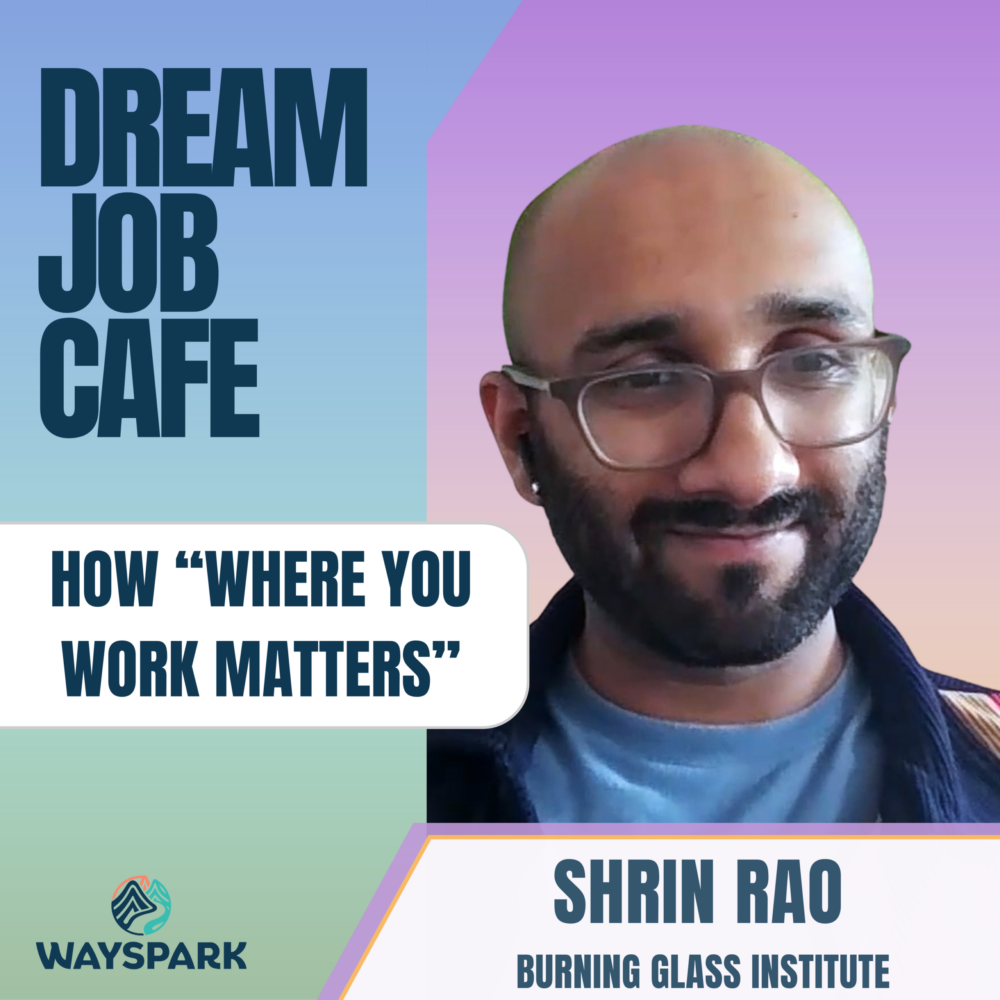
In this episode of Dream Job Cafe, I’m digging into the hidden architecture of the American career with Shrin Rao, Director of Workforce Innovation at the Burning Glass Institute. We’re moving beyond the glossy “Best Places to Work” brochures to look at the objective data that proves your employer is the biggest factor in your economic mobility.
We’ve all seen the headlines about the “Best Places to Work.” But let’s be honest: in many cases, those lists are just a measure of which HR department was best at nagging their employees to fill out internal surveys. I’ve seen this firsthand at companies where there’s immense pressure to record testimonials about how “awesome” it is, even when the reality is quite different.
The Burning Glass Institute is a nonprofit data laboratory that decided to take the human bias out of the equation. By looking at real-career histories—longitudinal data from millions of workers—they can track where people start, where they go, and how fast they move up. They tag this data with employers, school backgrounds, and geographic locations to find out what actually moves people ahead in a crazy world.
If you’re a career seeker or a legal professional looking to pivot, you need to nuzzle around the “Where Your Work Matters” tool. It doesn’t just rank companies by their bottom line; it ranks them by their investment in their talent infrastructure.
What’s shocking is the divergence. Workers at “Platinum” ranked firms (the top 20%) are 68% more likely to be promoted within five years and 50% more likely to get paid more for the same role compared to their peers at other firms. Industry isn’t destiny; whether you’re in tech, healthcare, or—surprisingly—insurance, the strategic choices an employer makes about training and internal mobility are what determine your outcome.
While the list includes household names like Accenture, which scores “Platinum” across Business Intelligence and IT System roles, it also features companies you’ve probably never heard of. Companies like Epsilon or West Monroe might not have the brand recognition of a Silicon Valley giant, but the data suggests they are providing a superior launchpad for early-career professionals.
The other side of the Burning Glass mission is the Credential Value Index (CVI). We’re in a unique moment with AI where context and skills matter more than ever, but knowing which certification to chase is a nightmare.
The CVI acts as a “nutrition label” for non-degree credentials. For example, if you’re looking to become a UX Designer, the tool shows that some credentials offer a mere $400 wage gain, while others can land you an average increase of $12,000. It covers everything from skilled knowledge work (like Six Sigma quality assurance) to skilled trades (like certified welding supervisors). For the first time, we have hard data on the ROI of alternative learning, which is a massive win for anybody looking to forgo the traditional four-year degree route.
Shrin Rao’s personal journey is just as interesting as the data he mines. A finance graduate from the University of Texas who started at the Boston Consulting Group (BCG), Shrin eventually felt the pull toward mission-oriented work. After getting his MBA, he moved into the nonprofit space—a move that many think is a “slow down,” but Shrin argues it’s quite the opposite.
“Nonprofits have often lacked the business acumen prevalent in the corporate space,” Shrin notes. By bringing that high-level data strategy to the Burning Glass Institute, he’s helping to solve the information asymmetry that has kept many workers stuck on the bottom rungs of the ladder.
The Burning Glass Institute is an independent nonprofit dedicated to advancing economic mobility through data. By providing visibility into the labor market and the efficacy of various learning pathways, the Institute empowers individuals and institutions to make smarter choices about the future of work.
Ready to see if your current employer makes the grade? Listen to the full episode or visit the Burning Glass Institute. Be sure to visit Legal Broadcasting Company often for our latest podcasts.
This article was written by Legal Broadcasting Company, and is based on the episode of Dream Job Cafe hosted by Larry Port.
The Institute applies “occupational controls.” This ensures they are comparing like-for-like—software engineers to software engineers, and customer service reps to customer service reps—so that tech giants don’t dominate the list simply by having high-paying roles.
The research shows that in the age of AI, early-career hiring is an investment in “talent infrastructure.” Bringing in talent early to gain context into your specific business is one of the best ways to combat the “low hire, low fire” market dynamics.
You can access the public site at the Burning Glass Institute’s official website or check out the profile in the Wall Street Journal that appeared in late March.