Shrin Rao, Director of Workforce Innovation at the Burning Glass Institute, joins the show to unveil the revolutionary “Where You Work Matters” study. Following Larry’s opening thoughts on the data behind career plateaus, Shrin explains how your specific choice of employer—not just your job title—dictates your long-term economic mobility.
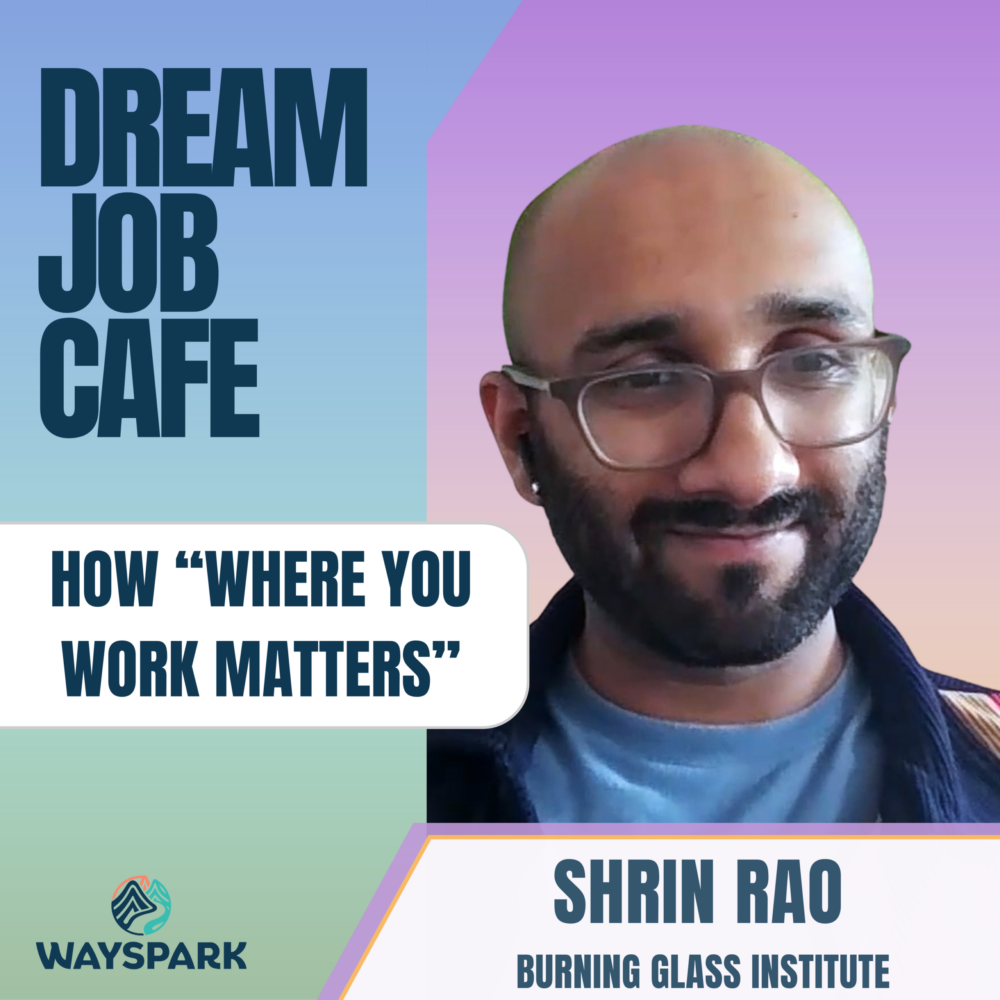

Finding a career path that leads to long-term financial success often feels like a guessing game, but big data is finally bringing clarity to the labor market. This deep dive features Shrin Rao, Director of Workforce Innovation at the Burning Glass Institute, as he unveils the “Where You Work Matters” study—a revolutionary ranking recently profiled by The Wall Street Journal.
Unlike traditional “Best Places to Work” lists that often rely on internal surveys or “pay-for-play” models, this research analyzes the actual career histories of over 12 million workers. The goal is simple: to identify which companies truly drive economic mobility and which ones leave employees stranded in dead-end roles.
The conversation explores why certain employers offer 68% higher promotion rates and 50% better pay for the exact same roles compared to their competitors. We also navigate the Credential Value Index (CVI), a tool designed to act as a “nutrition label” for non-degree certifications. Whether you are considering a transition into UX design, welding, or IT, understanding the ROI of your training is essential in the 2026 economy.
What We Cover:
Larry Port (00:00):
Dream job or nightmare? It’s hard to know if a career that looks great on paper will actually lead you to the life you want to live. So welcome to Dream Job Cafe. I’m Larry Port. I’ll be asking different professionals the questions you won’t find anywhere else. So grab a coffee, settle in. This is Dream Job Cafe.
Shrin Rao (00:19):
Sponsored by Wayspark.co, where we help people navigate careers in a crazy world.
Larry Port (00:25):
Hi everybody. Welcome to another episode of the Dream Job Cafe. It’s my great pleasure today to be with you with Shrin Rao. He is the director of workforce innovation at the Burning Glass Institute. So Shrin, welcome to the podcast. How are you today?
Shrin Rao (00:41):
Doing well, doing well. Thank you so much for having me.
Larry Port (00:44):
I’m really excited about this podcast. It’s not going to be the typical one we do on Dream Job Cafe where we explore careers, although we might do a little bit of that towards the end. But really Shrin’s team, these guys at Burning Glass Institute are part of a whole ecosystem of people trying to understand labor markets, education advancement. I mean, I guess, Shrin, I’ll let you do a better job of describing your organization’s mission.
Shrin Rao (01:09):
Yeah, so we’re the Burning Glass Institute. It’s a nonprofit data laboratory that studies the future of work and the future of learning to really unpack the drivers of economic mobility and opportunity. In other words, what moves people ahead? What moves people up? What helps get people started on the career ladder with the goal of advancing economic mobility for all.
Larry Port (01:31):
Okay, fantastic. And there’s a lot of eyes on this space right now for better or worse and for whatever reason. I mean, you have a labor market that’s locked up a little bit in terms of people being able to come or go from companies right now. And you also have a lot of AI uncertainty. Is this a new element for you guys or have you guys been seeing this play out for years before the rest of us have?
Shrin Rao (01:58):
So the Burning Glass Institute started in 2022. We’ve been in this space for a few years and it’s been a really tumultuous few years, as you can expect right at the advent of AI, right as everyone is trying to understand what does this mean for the labor market? What does this mean for opportunity? What does this mean for young people? And so these are really, I hate the word unprecedented because it’s thrown on way too often these days, but we are really in a unique moment with a lot of turbulence in the landscape, especially for young graduates. It’s really concerning for everyone at the Institute. We are trying to think about how can we bring more clarity and visibility into the opportunity landscape, what’s continuing to move people ahead. And so yeah, that’s part of our mission and what we do.
Larry Port (02:43):
Now, you guys, for an organization that’s been around for three years, congratulations because you were just profiled in the Wall Street Journal. The work that you did, where you work matters. For casual readers of the journal that may have seen a headline about best places to work in America, if you got into the meat of the article, it talked about this study that the Braden Glass Institute was working on. You want to talk a little bit about that before we get too deep into it, overview, how it started?
Shrin Rao (03:12):
Yeah. So as I mentioned, we study economic mobility and we have access to really big data sets around how people start and move through their career. And we tag those data sets with people’s occupation, people’s employers, where you went to school, if you went to school, where you live. And we do analysis, big data analytics on that data to try to figure out what moves workers ahead. And one of the main things we realized along with our partners at the Schultz Family Foundation and the Harvard Business School Managing the Future of Work Project is that where you work is one of the big drivers of what moves people ahead. Some employers are much better at investing in their workers and creating opportunity for them and moving them ahead. But we realized that people today didn’t have very much visibility into that. A lot of these best places to work lists, you may or may not be aware, but it’s effectively who’s best at filling out some of these internal surveys and getting their folks to fill them out.
(04:14):
Some of them are pay for play. We want to create something different that was grounded in real objective data that we could observe around career histories so that we can give people visibility into who were some of those companies and jobs that were creating most mobility for people.
Larry Port (04:31):
So what’s so fascinating about this is because when you think of economic mobility, the first thing that comes into people’s minds is, well, at least to my mind, is that I’ve always heard that it was the community colleges that were really a major stepping stone in education. But here this is saying, not to say that those things aren’t effective, but this is just almost like hiding in plain sight truth that where you work is equally as important, as important, or I don’t know, but a major factor in determining your economic outcome, correct?
Shrin Rao (05:06):
Absolutely. So some of those things you mentioned, school factors, the socioeconomic factors, those are also things that we study and think about. And that’s things that I think most of America understands is that education is a big driver of economic mobility, but a lot of this thinking and conversation stops when you finish school, when you start your first job, and we don’t really think about economic mobility after that, which we think is a big shortcoming of the broader space. So we want to broaden the conversation and show that most of people’s careers happen after school, and we want to make sure that we are setting people up for success in that period of your career, making sure that you can navigate to the spaces that will move you at. So
Larry Port (05:55):
For people that are getting their career journey or changing their career journey, this is very important to keep in mind that certain places will advance you more than others. And to kind of case in point with what Srin was talking about, a lot of these Best Place to Work awards are pay to play. So I keep throwing my old company Ultimate Software under the bus, but I have to do it again because they used to champion the fact that they were on these best place to work list. And what would happen is that once a year, you’d be under a lot of pressure to fill out these surveys and make videos and testimonials about how awesome it was to work at Ultimate Software. And you felt obligated to do it because if you didn’t, that could somehow negatively affect you. So I never believed in the award.
(06:47):
I thought working there was not that great, but I think it’s important to go in with your eyes open that certain places advertise this, but it might not always necessarily be the case. Now, what you did was pretty cool. I read about this. You were able to get advancement information off of LinkedIn and you did all sorts of clever things like this, right? Can you talk a little bit about how you figured out to get to the real skinny of all this?
Shrin Rao (07:18):
Yeah, the methodology is unique. You could think of this as a really large scale survey of how people report their careers online. So Larry, I don’t know exactly where you started your career, but you may have represented that I started my career as job X at Ultimate Software, and then I moved on to JobY at Amazon or what have you. And so we’re able to capture all of that and put it into a parser using natural language and other AI techniques to catalog individuals into what employers they’re working for, what jobs they hold, how many years of experience they have, all of those sorts of things. And we track them over time using this data so we can see your longitudinal career history. And then we apply a set of occupational controls so that we’re comparing customer service representatives to other customer service representatives and software engineers to other software engineers so that we’re not having this kind of occupational variance.
(08:20):
A lot of best places to work lists are dominated by tech companies because they have these very highly paid employees and software engineering and what have you. So we wanted to control for that. And so our occupational controls make sure we’re comparing like for like. And then we calculate a set of metrics that we think are important to assessing what a worker’s experience is. Those are wages, those are promotion rates, those are retention rates, and those are how well you’re able to move into a better job after you leave the company. And so we classify those into a few different archetypes of good jobs. So isn’t that specific employer a good first job? Is it a good growth job? Is it a good stability job? And then to build this where you work matters list to badge top performers across each of those archetypes and overall four different job categories.
Larry Port (09:18):
Right. And so they have gold and they have platinum, right? No silver award though. So we’re not doing silvers. We’re just doing gold and platinum,
Shrin Rao (09:26):
Right? Gold and platinum. The goal is to make sure that companies want to recognize their performance on this list and invest into reaching that next threshold and tranche of performance. So the badges are platinum for the top 20% of employers and gold for the next 20% of employers. And we’ve gotten really good reception from employers who want to promote their space on this list and they recognize the value in a really objective third party outside in validation of what they’re doing to invest in their workers. And we hope this creates a virtuous cycle of greater investment for fourth companies who want to move up.
Larry Port (10:09):
Yeah, it’s such a great tool, and I think we should probably take a look at it. The one thing is that I read the statistics where it’s 1,750 employers and 12 million workers went into this dataset and like 55,000 jobs or are those like the ONET classifications that we’re talking about or is that what that is?
Shrin Rao (10:32):
Exactly. I don’t know to what degree your listeners are aware, but the government has-
(10:38):
They’re probably not. Yeah. It gets pretty wonky, but the government has its own classification system of occupation of over 900 different occupation categories. We clustered them into a few groups, putting similar occupations together and then assessed each of those occupations, like I said, on a like- for-like basis so that we’re comparing people doing the same job at the same company. And we find that even for in those cases, workers doing the same job. So workers in platinum ranked employees, so the top badge are 26% more likely to stay at their employer for three or more years. They’re 68% more likely to be promoted within a five-year span. They’re 38% more likely to find a better exit opportunity when they leave, and they’re almost 50% more likely to get paid more for the same roles. So there’s really staggering differences here for workers doing the same job based on who their employer is.
(11:37):
That’s kind of the big finding of this work.
Larry Port (11:39):
So it really does have an impact. And so I guess we should probably take a look at it. So if you don’t mind, why don’t we share your screen and pull up the Where Your Work Matters tool. It’s so great, I think, for career seekers and people trying to figure out what they want to do for a living to play around with this because not just because of the data itself, but I think it really gives insight into what is out there. What is the universe of careers? One of the shocking things for me about this list is how many insurance companies were on it and how many insurance companies were ranked well. Because it’s not like I typically have fond feelings for necessarily insurance companies, but here they are treating their employees really well and with lots of opportunities for advancement. And then inside those companies, there’s all sorts of different roles.
(12:24):
So somebody might be interested in being working in statistics or working in this field or working in that field. Your tool allows you to go across all these different industries and all these different companies and see what roles there are. So to me, I think just the exploration itself of the tool has value. Okay, so keep going. Here we go.
Shrin Rao (12:47):
Yeah. So this is the site, and this is a public site available to everybody. You can explore different companies, what their badging is. And like you said, there’s a lot of insurers on this list, but we have pretty broad representation of employers across different sectors. There’s tech companies, there’s healthcare companies, there’s Boeing and Northrop and other companies as well. So there’s a pretty wide range. And this list here is just the 22 companies that are platinum ranked for all three archetypes, growth, stability, and early career. And then we have a full area where you can explore the full list and see every company from A to Z that we’ve assessed of the 1750, you can look up a company by name, and then you can even click through into a company and try to understand how they do on different occupations. So here on the right, you can see some of the most common occupations for this company, Accenture, which is a global professional services company.
(13:56):
Maybe some of your listeners have heard of them or looking for opportunities there. You can see there’s business intelligence analysts, there’s platinum ranked for early career for BI analysts, platinum ranked for IT systems, analysts, management analysts, software engineers, a lot of roles that are common and interesting for the start of your career. And then you can expand this list and see all of the occupations that we have in sufficient data for … We rank HR, we rank operations, financial advisors, sales engineers, talent directors. So a pretty broad spectrum of workers across different occupation groups we’re able to get enough data for, and some of them are badged across each of these categories.
Larry Port (14:45):
Yeah. So a couple things. Accenture’s a pretty famous company. So there’s a lot of household names on this list. There’s also places I’d never heard of. They’re still very large companies with all these amazing opportunities that treat their people well. The other question I had for you that I was thinking of, I’m looking at this thing and there’s art director is somebody listed on this thing for Accenture, which is amazing. But are there certain occupations that tend to score higher across companies or is that not really surfaced through your research?
Shrin Rao (15:21):
What you see here is effectively a assessment of occupations relative to other employers. So you’re not able to see through this tool whether a facilities manager or a financial analyst is quote unquote better, but you can see is a financial analyst at Accenture higher badged than a financial analyst at some other company. Does that make sense?
Larry Port (15:50):
It makes total sense just because it’s relative, it won’t let you do that. But one thing that I’m thinking is that if I’m a career seeker, I would definitely get on this tool and just start nosing around because I think what you’re going to find is that there’s going to be a lot of occupations hidden amongst all these places that you may not have even thought about. And then the other thing is that if you go to your career fair, you start collecting business cards for people, take a look, see where they rank on this list, because I mean, if one of the findings of the research is that your economic mobility is greatly affected by where you work, then it should be a major consideration when you prioritize where you might be applying. One of the things I thought was really cool was, can you show people the compare jobs tab?This is really interesting.
Shrin Rao (16:40):
Yeah. So let’s pick some companies. Who do you want to compare?
Larry Port (16:45):
Oh, let’s pick one that I didn’t know about. So I found a couple of the consulting companies. I had never heard of West Monroe before, but they scored well.
Shrin Rao (16:58):
So yeah, here we could pick West Monroe. We can look at different occupations, say either data science, we can compare them to someone else who has data scientists- There’s Boston Consulting
Larry Port (17:11):
Group. I didn’t even know them.
Shrin Rao (17:12):
Yes. And so then you can compare data scientists at West Monroe versus data scientists at the Boston Consulting Group.
Larry Port (17:20):
And I have one more, Epsilon. I’d never heard of them either. But what’s cool about this is that, I mean, I would’ve loved this because when I was trying to do my career search, I mean, I would’ve been on this all the time. I would’ve looked at opportunities and then I would’ve cross-referenced it with your website.
Shrin Rao (17:40):
Yeah. I think that two big things that you said there. First is that a lot of the companies that people, especially young people are thinking about or applying to are those bigger household names, but there are lots of places that can give you a good start and a good career. So hopefully this list can give some visibility into some of those lesser known employers. And like you said, lesser known job categories, some that students may not be thinking about outside of the traditional paths, and there’s quite a lot of great opportunities and places to start your career.
Larry Port (18:14):
Right. So by the way, one of the things that I thought about when I saw this is that when I ran my company, I ran a software company and we had maybe 40 people, so we would not show up on a list like this, but we hired a lot of people directly out of college, and there’s probably a lot of small startups and businesses that do hire entry-level employees. And when you have a small business, you’re kind of just reacting. You aren’t able to plan for career progression like these big companies are. I wonder if there’s maybe any findings or any at least guideposts that you guys measure that maybe small employers could learn from to have better career outcomes for people that may be beyond the scope of your research, but just curious.
Shrin Rao (19:01):
Yeah, there’s a few takeaways I think that could be relevant for smaller businesses. One, especially in the age of AI is that some of these early career opportunities are really investments into your talent infrastructure. The age of AI means that context matters more and more. And so if you’re able to bring in strong talent early on, have them gain context into your business, that can make a big difference in the low hire, low fire type labor market that we’re seeing today. We’ve also found that there’s top performers on this list across industries. And so industry is not necessarily destiny. A lot of these companies that come to the top of this list are due to the strategic choices they’ve made. And so we think small businesses in different sectors are dealing with different constraints, but we’re able to see companies in all different sectors rise to the top of this list and achieve strong performance.
(20:00):
So that’s a couple of things that maybe a small business can take away from this list.
Larry Port (20:05):
Yeah, it’s very cool. I don’t know if there’s anything else you want to mention about this, because the other tool that I was completely fascinated with was this credential value index navigator, which has to do with what certifications or training people need, and then what’s the ROI on those things? I guess that’s one way to summarize that, but I’m not sure if I’m doing it justice.
Shrin Rao (20:31):
Yeah. So let’s switch gears then and talk about the Credential Value Index. This is a very different resource, but kind of built on similar principles in that we want to objectively assess different non-degree credential opportunities based on which ones help move people ahead based on that similar career histories dataset that I mentioned previously. And so we published this, the credentialvalueindex.org. It’s a public resource that folks can use to explore different non-degree credential opportunities. And there’s a lot. We realized that this is a space that has a burgeoning set of different credential providers, your Courseras, your various MOOCs. You mentioned community colleges. It seems like everyone is trying to think about how do we offer alternative training and education programs, but there’s not a lot of clarity into which ones of those MOVE people head. And so that’s why we built this tool.
Larry Port (21:34):
Yeah. And is it in general across different fields or do these courses … Well, I guess I was going to say, do they support this whole kind of skilled labor, this like what they call maybe new collar, in between white collar and blue collar technician work or is it more … I was playing around with it and I saw stuff like UX designer and stuff where you could maybe forego a college degree and get trained. Is there any commonality to the types of careers in this thing?
Shrin Rao (22:09):
It is based on which credentials and certifications folks in the data represent as having earned. So you can think of it as it has a preponderance of different skilled or knowledge work related credentials, but there’s a really wide spectrum. We’ve got OSHA certifications, we’ve got more skilled trade certifications. It runs the gamut, but there’s certainly a lot of knowledge certifications on here.
Larry Port (22:40):
Okay. So I’m thinking of becoming a little bit more skilled in, let’s say, I want to become a UX designer. I can come here and I can look at the various programs that are available and see maybe which ones might have a better return for me, right?That’s kind of how it would work.
Shrin Rao (23:00):
Exactly. So I put in the search here for UX designer, and so we can look at here on the right, you see various UX design credentials. The top one here is UX design tools, Axure offered by LinkedIn. We have web design for usability offered by Interaction Design Foundation, user experience design also. So there’s a range of different options here in terms of credentials that are in the UX world. And then we’ve set a core set of metrics, really teach one. You can think of this as a nutrition label for credentials. We want to highlight what matters most to people who are thinking about earning these credentials. And we align on these core set of metrics. First is wage gains. So do people who earn this credential in the following year, how much more do they earn on average? People who earn this credential, how often do they land a new job that’s related to the credential?
(24:06):
And then how often do they move up in their current job, get promoted, et cetera? So those are the main metrics that we’ve isolated here for each credential. So you can sort, see which ones of these are offering the highest wage gains or most
(24:22):
Likely- Digital Film Academy is
Larry Port (24:24):
Rocking
Shrin Rao (24:25):
It. Yes. Digital Film Academy has a really strong rate of laying people into aligned jobs, UX Academy by Design Lab as well. And you can see there’s just a wide range here in terms of which ones are really strong and which ones are not. This one, UX Design Tools offers a $400 wage gain versus the top one, which is around $12,000. So the spectrum of options is really wide. Yeah. Yeah, exactly.
Larry Port (24:56):
No, think about it though. Let’s say that you want to go in a different direction and you want to get a certification. This is so much better than our Google search. You go in here and there’s actual hard data about what you might be able to expect. It’s really going to help choices and hopefully get everybody’s act together that aren’t doing so well on this list too. So you have a real advantage by using this. And I just want to point out again that this is from a nonprofit company. There are people out there that care about people getting jobs and their economic development as they go through the workforce. So you got people, you got wind in your sails is what I’m saying. This is phenomenal. Can we do another one that might not be maybe a blue collar search? What if somebody’s interested?
(25:44):
Would you have a welder or HVAC people in there or something?
Shrin Rao (25:47):
So here we have certified welding supervisor from the American Welding Society. A few of, it looks like American Welding Society is all over this list, certified welding inspector from the Hobart Institute of Welding Technology. So there’s a few of these welding related credentials. There’s just design related credentials, advanced manufacturing, Six Sigma. So some of these are adjacent to welding or related to welding. Some of these are direct welding credentials.
Larry Port (26:19):
Right. The Six Sigma stuff for those that aren’t in the know, it’s like kind of a quality assurance kind of system. So this might be for people that are working already in factories that want to get certified in quality assurance in a welding context and then kind of move up the chain is what I’m guessing that kind of stuff is. Exactly. Yeah. Well, this is phenomenal stuff. So I guess that brings me back to another question. I mean, the other thing I would like to highlight is there is a ton of research on your site. I was cruising through it. There were a bunch of interesting articles that were very, very valuable, I thought, to anyone thinking about their careers. So I would highly recommend going to the Burning Glass Institute website and taking a look around. Shrin, let’s switch gears one second here. Tell me about your decision to go into the nonprofit world and what has your career personally been like?
Shrin Rao (27:16):
Yeah. Where to start? I think a lot of people have some misconceptions about the nonprofit ecosystem. They think it may be slower. They think they are giving up a lot. I’ll say those aren’t necessarily the case. I was looking for an opportunity to use my career to do something meaningful and really have an impact and help people. I didn’t see as many of those clear intersections in the private sector, but I was hesitant for a long time. I was in the private sector. I was working in consulting, ultimately got an MBA, but I wasn’t feeling like I was really doing a purposeful, meaning-driven, mission-oriented work. So was wanting to explore opportunities in the nonprofit or government space where I could really make a difference in people’s lives. And I found that a lot of companies or organizations rather working in the nonprofit space are full of passionate people who want to work hard, who want to make a difference, and it’s really fulfilling.
(28:19):
It’s an awesome career trap.
Larry Port (28:22):
Wonderful. And what was your educational background, if you don’t mind me asking?
Shrin Rao (28:27):
Yeah, I started my education at the University of Texas where I got a degree in finance. I started my career at the Boston Consulting Group. Oh, there you go. I was going to make a joke and
Larry Port (28:40):
I just say, did you work in the Boston Consulting Group?
Shrin Rao (28:43):
Yeah, exactly. And then had a few kind of corporate type jobs for a little bit, got by MBA and then actually moved into the nonprofit side after BMBA, which is unusual. But nonprofits for a while have really lacked a lot of this strong business acumen and managerial skills that are more prevalent in the for- profit corporate space. And so there’s a strong need for those skills in nonprofit work. And so I’m happy to apply those skills for Goodnow.
Larry Port (29:18):
Oh, that’s fantastic. Again, the tool that we looked at today was called Where Your Work Matters, and we also looked at the Credential Value Index Navigator, and you can find all of this at Burning Glass Institute. If you look that up, it’ll lead you right to it. And there’s an awesome article in the Wall Street Journal about it that appeared in late March. So Srin, thank you so much for being with us today. Really appreciate it.
Shrin Rao (29:42):
Cool. Thank you so much for having me, Larry. All
Larry Port (29:44):
Right, folks, if you enjoyed this, then please like it and tell your friends. And if you can, be grateful for something today.
Shrin Rao (29:51):
Thanks for listening. Don’t forget to like and subscribe to Dream Job Cafe on Spotify, Apple Podcasts, or wherever you listen. And don’t forget to check out Wayspark.co, where we help people navigate careers in a crazy world.

Shrin Rao is the Director of Workforce Innovation at the Burning Glass Institute, where he applies big-data analytics and strategic acumen from his BCG background to advance economic mobility. He holds an MBA and a degree in finance from the University of Texas, focusing his career on the intersection of data science and social impact.